.avif)
Unlike a regular civilian divorce, a military divorce involves complex layers of federal law, Department of Defense regulations, and Texas state statutes. From dividing retirement benefits under the Uniformed Services Former Spouses' Protection Act (USFSPA) to handling deployment-driven custody schedules, every stage of this process comes with additional considerations.
If you’re stationed at or connected to Joint Base San Antonio, finding a military divorce lawyer in San Antonio, Texas who is well-versed in both federal service regulations and Texas family law is a critical first step. This guide highlights what makes military divorce different, how Texas courts treat these cases, and what you should do to prepare before filing.
How Military Divorce Differs from Civilian Divorce in Texas

Military divorces adhere to the same basic legal framework as civilian cases, but several federal rules create additional procedural and financial considerations.
Jurisdiction and Filing Requirements
Service members may file for divorce in Texas if the state is their legal domicile, if they’re stationed here, or if their spouse resides here. The state’s residency rules still apply: At least one spouse must have lived in Texas for six months and in the filing county for 90 days before the petition is submitted.
The Servicemembers Civil Relief Act (SCRA) can delay divorce proceedings if the active-duty spouse is unable to appear due to military service. This protection prevents default judgments while a service member is deployed or otherwise unavailable.
Division of Military Retirement Pay
Under the USFSPA, state courts may treat military retired pay as divisible property. However, direct payment from the Defense Finance and Accounting Service (DFAS) requires at least 10 years of marriage overlapping with 10 years of creditable military service — the so-called "10/10 rule".
Even when direct DFAS payments don’t apply, the former spouse may still receive a share of retirement through other enforcement mechanisms. A military divorce lawyer in San Antonio can review the service member's Leave and Earnings Statement and retirement projections to determine the community property portion accurately.
Healthcare and Benefits After Divorce
A former military spouse may retain TRICARE coverage for up to one year after divorce under transitional benefits. Full continued TRICARE eligibility requires meeting the 20/20/20 rule: 20 years of marriage, 20 years of military service, and 20 years of overlap between the two.
Key Benefits Affected by Military Divorce
- TRICARE health coverage and transitional eligibility
- Commissary and exchange privileges
- Base housing allowances and assignment of quarters
- Survivor Benefit Plan (SBP) elections and former spouse coverage
- Thrift Savings Plan (TSP) division under court order
Documents to Gather Before Filing for a Military Divorce
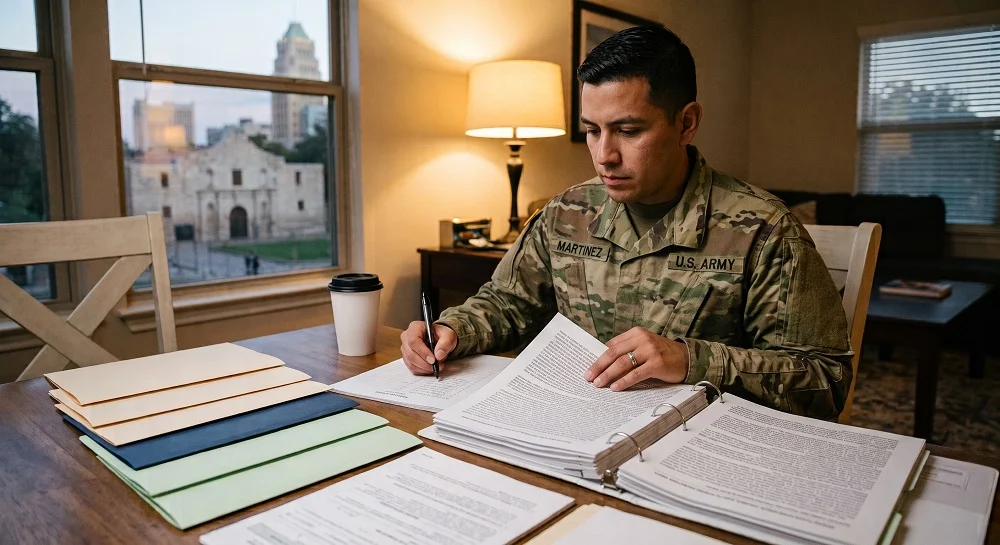
Having the right records ready before your first consultation will help your attorney assess your finances, benefit eligibility, and custody situation from the outset.
Key documents may include your Leave and Earnings Statement, retirement point summary, TSP statements, Survivor Benefit Plan elections, TRICARE enrollment verification, VA disability rating documentation, PCS orders, and deployment history.
You should also gather tax returns, bank and investment statements, property deeds, mortgage documents, and any existing court orders or custody agreements.
Complete and well-organized paperwork allows military divorce lawyers in San Antonio, Texas to identify community property, calculate benefit timelines, and build stronger cases.
The Military Divorce Process in San Antonio: Step by Step
Military divorces follow the same general timeline as civilian divorces in Texas, but federal protections and military-specific requirements can extend or modify each stage. Here’s an overview of how your case will proceed.
Step 1: Verify Jurisdiction and Residency
First, you must confirm that Texas has jurisdiction over the case. For service members who are stationed or deployed outside the state, this may depend on factors like legal domicile, physical presence, or the spouse's residence.
Step 2: File the Divorce Petition
One spouse will file the petition to terminate the marriage, which starts the 60-day mandatory waiting period under Texas law.
Step 3: Serve the Petition or Obtain a Waiver
The other spouse must formally be served with the Petition for Divorce. If the service member is deployed at the time, the SCRA permits the proceedings to be postponed until they can respond.
Step 4: Seek Temporary Orders If Appropriate
The court may issue temporary orders relating to child support, housing, bill payments, and interim custody arrangements while the divorce case is pending.
Step 5: Undergo Discovery and Financial Review
Both sides must exchange financial records. In military cases, this often includes Leave and Earnings Statements, retirement point summaries, TSP statements, and benefit documentation.
Step 6: Enter Mediation or Negotiation
Most Texas courts encourage (or require) mediation before trial. Our experienced military divorce lawyers in San Antonio can help you prepare with clear settlement positions on retirement division, custody, and support before entering mediation.
If you’re unsure whether divorce is the right step, our resources on how to know if you’re ready for divorce may help you make a decision.
Step 7: Await the Final Decree
The case concludes with a signed final decree that sets the terms for property division, custody, support, and enforcement rights. In military cases, the decree must include specific language acceptable to Defense Finance and Accounting Services if military retired pay will be divided.
Child Custody and Parenting Plans in Military Divorce
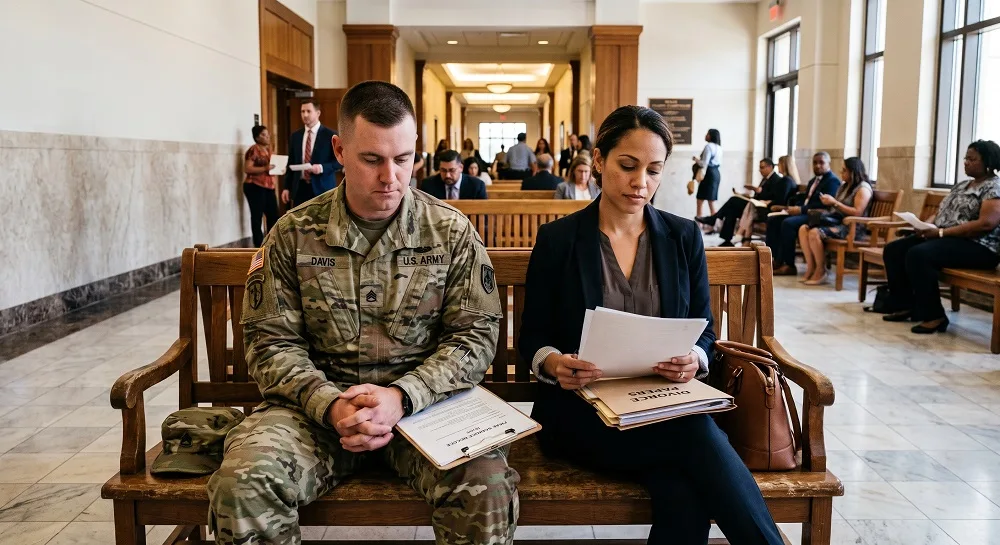
Texas courts make custody decisions based on the “best interest of the child” standard articulated in Texas Family Code § 153.002. For military families, frequent relocations, deployments, and temporary duty assignments can complicate things in a way that doesn’t happen in civilian cases. Here are a few key points worth considering.
Deployment and Custody Modifications
According to Texas Family Code § 153.702, a service member may designate someone else (such as a grandparent) to exercise visitation during a deployment. This temporary designation doesn’t permanently change the underlying custody order.
If deployment schedules create repeated disruptions, either parent may petition the court for a modification. When evaluating modification requests, courts look at whether a material and substantial change in circumstances has occurred since the original order was signed.
Parenting Plans for PCS Moves
Permanent Change of Station orders can send a military parent across the country or overseas. When both parents share custody, a PCS move may prompt a child relocation or parental relocation dispute.
Lishman Law helps military families create nuanced parenting plans that address long-distance arrangements, virtual visitation provisions, and holiday or summer possession schedules that account for the realities of military service.
Property Division in a San Antonio Military Divorce
Texas is a community property state. Under state law, courts divide marital property in a manner that’s "just and right". In military cases, this involves evaluating military-specific assets alongside standard community property.
Some of the military assets that are subject to division include:
- Military retired pay earned during the marriage
- Thrift Savings Plan contributions made during the marriage
- Veterans' disability compensation (generally separate property, with exceptions)
- Military housing allowances and their impact on property acquired during service
- Bonuses, incentive pay, and special-duty pay received during the marriage
VA Disability vs. Retired Pay
Federal law generally prohibits state courts from dividing VA disability compensation as marital property. When a retiree waives a portion of retired pay to receive disability benefits, the former spouse's share of retired pay may be reduced.
Our military divorce lawyers in San Antonio help clients understand how disability waivers might affect the overall property settlement.
Spousal Support and Maintenance in Military Divorce
Texas courts may award spousal maintenance when a spouse meets specific eligibility requirements, including marriage duration, inability to earn sufficient income, family violence, or disability.
In military cases, courts may also consider the non-military spouse's years spent supporting the service member's career, frequent moves that disrupted employment, and the gap in earning capacity those sacrifices created.
Protect Your Service, Your Family, and Your Future
Divorce can touch every part of a military family's life, from retirement pay and health insurance eligibility to custody schedules built around deployment cycles. The rules are different, and the decisions you make now can follow you well beyond your or your spouse’s service.
If you're stationed at Joint Base San Antonio or are a military spouse wondering what comes next, the compassionate family law team at Lishman Law can help you weigh your options and take the right steps forward. Contact us today to schedule a free case evaluation.


Need Help with a Military Divorce? Talk to Our Team Today.
If you’re a service member or military spouse facing the possibility of divorce at Joint Base San Antonio, our family law attorneys can help. Contact our office at (210) 880-1707 to schedule a free case evaluation.