.avif)
Divorce in Texas extends beyond property division. Allocation of debt often becomes a central point of dispute. Credit cards, mortgages, medical bills, and business obligations frequently raise questions, particularly when spouses contest responsibility. Texas applies a community property system that governs how courts classify and assign financial obligations.
San Antonio divorce attorneys regularly see how these financial questions connect with court procedure, case timing, and other issues addressed throughout the divorce process. Once a divorce begins, defined legal stages follow, each involving decisions that shape long-term financial obligations and family arrangements.
Community Property and Debt Division in Texas

Texas follows a community property system, meaning courts distinguish between community and separate assets and debts when determining responsibility in a divorce.
Under Texas Family Code §3.002, debt acquired during marriage generally qualifies as community debt unless an exception applies. This includes liabilities created by either spouse, regardless of whose name appears on the account.
Courts divide community debt under the “just and right” standard set out in Texas Family Code §7.001. An experienced divorce attorney reviews the nature of the obligation, its purpose, and the overall division of assets when assigning responsibility.
Separate debt typically includes obligations incurred before marriage or tied to separate property, provided sufficient proof supports that classification.
Separate debt also applies if it is clear that the lender intended to look only to one spouse for repayment.
How Texas Community Property Law Shapes Outcomes
Texas law presumes debt acquired during marriage belongs to the community estate. That presumption places the burden on the spouse who claims separate responsibility.
Under Texas Family Code §3.003, clear and convincing evidence must support any claim that debt remains separate. Courts may also divide debt unequally under § 7.001 when circumstances such as fraud or misuse of marital funds justify adjustment.
Financial obligations continue while a divorce is pending. Missed payments may affect credit, and courts often issue temporary orders that assign payment responsibility during the case, including in contested matters filed in San Antonio. Early review of credit reports can reveal obligations that require attention before final orders are entered.
What Debt Gets Divided in a Texas Divorce
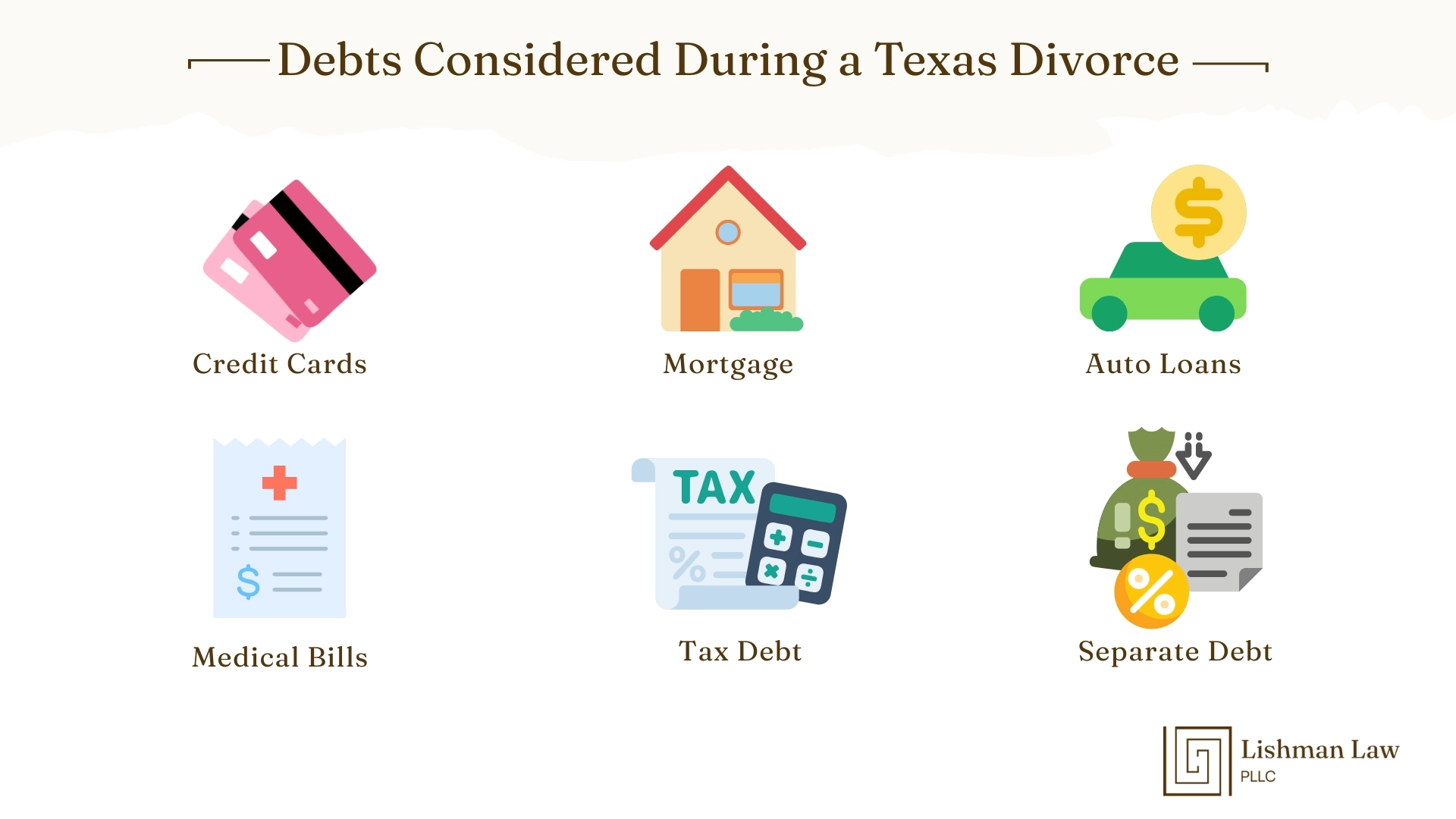
Certain obligations give rise to repeated disputes during divorce proceedings. Marital debt refers to any debt accumulated by either spouse during the marriage, and disputes often arise over who is responsible for a spouse's debts, especially when both parties may be held liable regardless of individual awareness.
Credit Card Debt

Credit cards often generate the most disagreement. Charges may include a mix of household purchases and personal spending. Disputes arise when one spouse claims the other accumulated excessive balances, or made charges that didn’t benefit the other spouse.
Mortgages and Home Equity Loans
Real estate debt presents complex issues, especially when one spouse seeks to keep the home. Refinancing may become necessary to remove the other spouse from liability. Without refinancing, both parties may remain exposed to liability for missed payments or foreclosure.
Medical Debt
Medical bills incurred by a spouse during marriage typically qualify as community debt. Disagreements often focus on elective procedures or expenses incurred close to separation.
Business Debt
Loans tied to closely held businesses create valuation and responsibility issues. Courts assess whether the business qualifies as community property and whether the debt supported operations or was for personal use.
Car Loans
Car loans acquired during marriage usually qualify as community debt under Texas law, even when only one spouse appears on the loan. When one spouse keeps the vehicle, that spouse will generally assume responsibility for the loan. This may require refinancing to remove the other spouse from liability, or trading in the vehicle if there is no other option to remove the other spouse from the note.
Separate Debt
A debt does not become separate property solely because it appears in one spouse’s name. Separate debt typically includes student loans incurred for one spouse’s education, liabilities associated with inheritances or premarital assets, and specific obligations arising after separation.
Decisions regarding debt responsibility often influence the overall cost of divorce, particularly when disputes require extended litigation or the involvement of financial experts.
How Courts Decide Who Pays Which Debt in Texas
Judges in Texas do not simply divide each bill down the middle. Courts review multiple factors to determine fairness.
Key considerations are:
- Which spouse incurred the debt
- The purpose of the obligation
- Whether the debt benefited the household
- Each spouse’s earning capacity
- Fault grounds, such as adultery or financial misconduct
- Disparities in asset division
For example, a credit card used for family expenses may shift to one spouse if that spouse also receives a greater share of marital assets. A mortgage may remain tied to the spouse who keeps the residence, even if both names appear on the loan.
Court orders allocate responsibility between spouses, but they do not alter contracts with creditors. If both parties are named on a debt, a creditor can look to both parties for satisfaction. Missed payments can result in damage to a former spouse’s credit, even if the debt was assigned to the other party in the decree.
Additional considerations may apply in military divorce cases, where federal regulations or service-related obligations affect how debt is classified and assigned.
Common Mistakes That Increase Financial Risk
Debt division problems often stem from avoidable errors.
Frequent mistakes are:
- Closing accounts without agreement or court approval.
- Accumulating new debt after separation.
- Failing to obtain complete account records.
- Assuming court orders bind creditors.
- Ignoring tax consequences of a property division.
Another common error involves informal agreements between spouses that lack enforcement power. Without written orders, liability may remain unresolved.
Protecting Yourself and Your Credit During Debt Division
Debt division in a Texas divorce can affect credit long after the decree. Because community property law may leave both spouses exposed to joint obligations, missed or disputed payments often damage credit for both parties.
Protective steps often include reviewing credit reports to identify all joint accounts, limiting new charges on shared credit cards, and confirming payment responsibility during the case.Continued payment on joint debts during the divorce process also reduces the risk of late fees and credit damage.
Effective steps involve:
- Collect account statements for at least two years.
- Document the purpose of major charges.
- Avoid new debt during the case.
- Monitor joint accounts regularly.
- Confirm payment arrangements in writing.
One tip often shared with clients involves debt tracking. That record supports classification arguments and limits surprises during settlement talks.
Final Thoughts on Debt Division in Texas Divorce Cases
In Texas, the outcome of debt division often depends on how accurately financial records are identified, how clearly obligations are classified, and how consistently Texas community property law is applied.
At Lishman Law, our family law attorneys bring structure and clarity to divorce matters involving complex financial issues.
If you are ready to address debt division in your divorce, schedule a case evaluation with Lishman Law to review your circumstances, examine available options under Texas law, and take informed steps toward a workable resolution.


Let an Experienced Divorce Lawyer Handle Your Case
Schedule a case evaluation with Lishman Law to review divorce considerations under Texas law.